
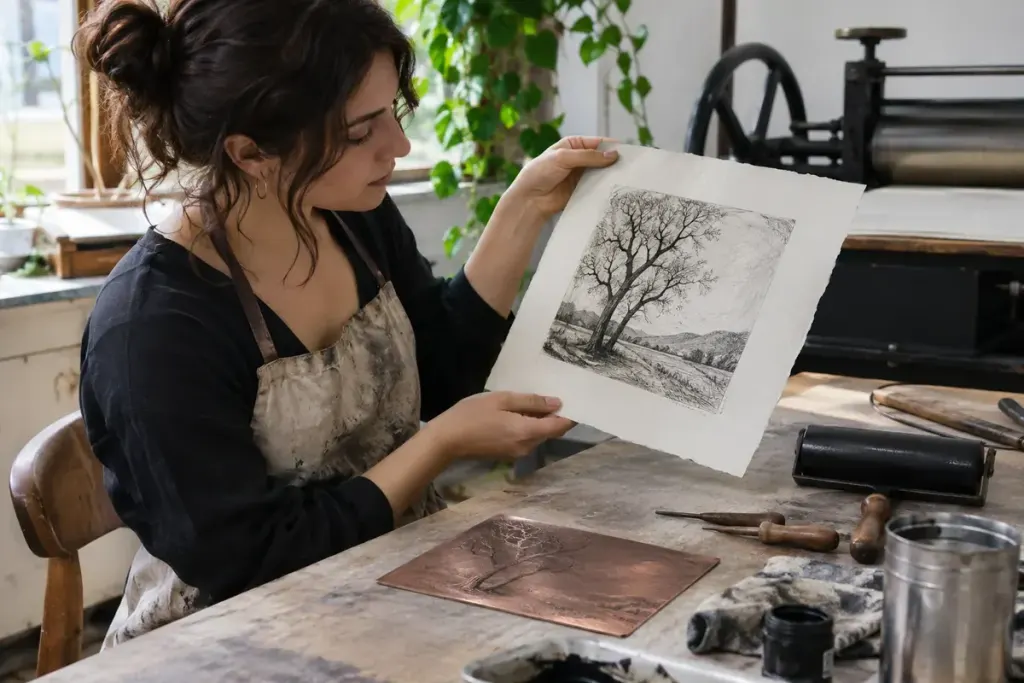
A black line in a print can have a soft fringe that makes it feel almost drawn in charcoal. In drypoint, that quality can come from metal displaced by the artist’s needle rather than from a blurred photograph or careless printing.
The Metropolitan Museum of Art’s explanation of drypoint describes a needle scratching directly into a plate. The raised material beside the incision is called the burr. It holds ink and contributes to the characteristic rich edge.
Look at the edge as well as the centre
Choose one short line in a museum’s high-resolution image. Follow it through a light area and into a darker passage. Does the edge remain equally soft? Does the line broaden where marks overlap? These are observations to record before deciding which technique produced every part of the image.
Artists can combine drypoint with other printmaking methods. A work labelled “etching and drypoint” is a useful reminder that a single sheet need not have one uniform kind of line.
In its collection entry for Dürer’s The Holy Family, the Met specifically connects the drypoint burr with the soft shadow around the figures. The object gives a concrete place to test the general description with your eyes.
Why two impressions may differ
The burr is delicate and wears with printing. That helps explain why impressions from a plate can differ, although ink, wiping, paper and later work on the plate also deserve attention. Avoid dating an impression from softness alone.
For a small comparison exercise, place two authorised museum images side by side and select the same passage. Note the collection numbers, stated medium and image scale. Then write three visual observations without using “better” or “worse.” A lighter line may be easier to describe accurately once you stop treating darkness as a quality score.
If you want to try the process, begin with a supervised printmaking session and the studio’s materials and safety instructions. Understanding the burr gives you a useful question to bring: how does this plate and printing method preserve, alter or remove the raised edge?