
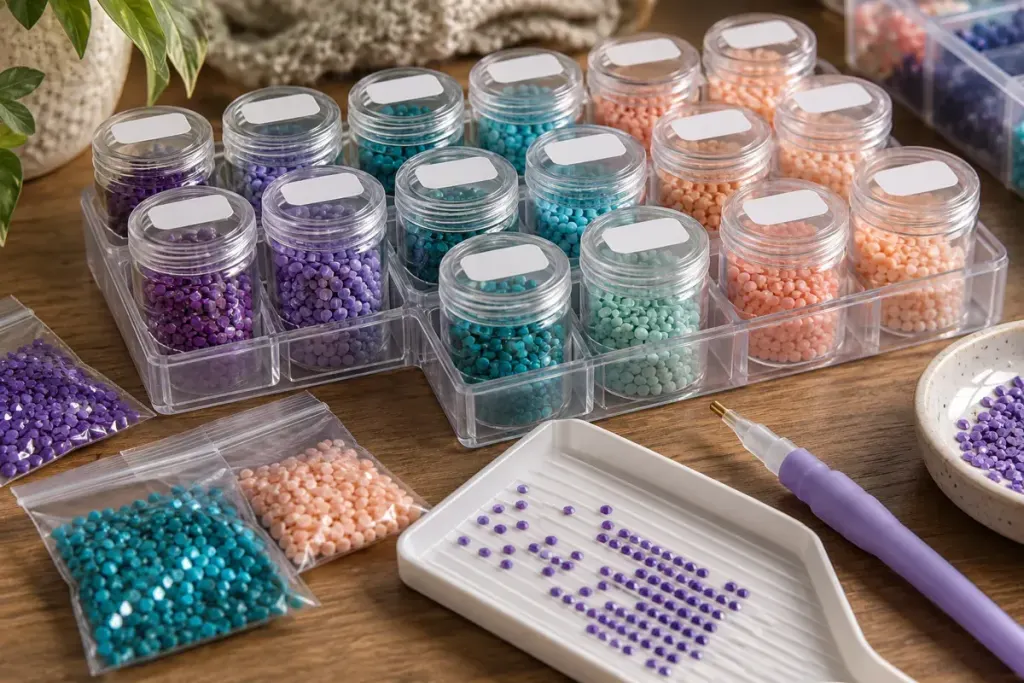
Two pale pink drills can look identical in a tray and noticeably different on the canvas. The safest moment to identify them is while each colour is still beside its original label.
Diamond Art Club’s storage guidance recommends labelled containers and keeping supplies organised. Its colour-code advice is useful, but always follow the actual key supplied with your kit rather than assuming every brand uses an identical system.
Make a label with three jobs
For the active project, include the canvas symbol, the kit’s colour reference and a short project identifier. The identifier matters when two projects occupy the same table. A code that is meaningful within one kit may be less helpful once several bags are mixed together.
Write labels before pouring. Place one empty container next to one bag and compare both with the canvas key. Finish that colour and close the container before starting another. It is slower than opening every bag, but easier to recover from an interruption.
Test the container with your hands
Can you open it without jolting the contents? Does the lid stay secure when placed in the storage box? Is the opening suitable for returning unused drills from the tray? An elaborate organiser is not automatically better than a simple system you can use comfortably.
Keep small parts away from children and pets, and keep drinks outside the sorting area. Good lighting helps distinguish labels, particularly where two symbols differ by only a small mark.
Create a place for uncertainty
If loose drills have lost their identity, put them in a separate container labelled “unidentified.” Do not pour them into the nearest-looking colour simply to clear the table. Compare carefully with the kit information or ask the supplier for help before using them in a visible area.
The same principle applies to leftovers. Record project, colour reference, drill shape and any special finish. Do not assume pieces from another manufacturer will match precisely because the printed number looks familiar.
A closing routine in four moves
- Match the tray contents to the open container before pouring.
- Close the container and return it to its assigned position.
- Cover the exposed canvas using the kit’s approved covering.
- Leave a short note identifying the section you were working on.
That note can be as simple as “upper flower, symbol triangle, container D7.” It reduces the time spent reconstructing yesterday’s decisions.
For a shared dining table or a short evening session, combine this system with a small-section working plan. Organisation should make the craft easier to return to, not become a second project in its own right.