
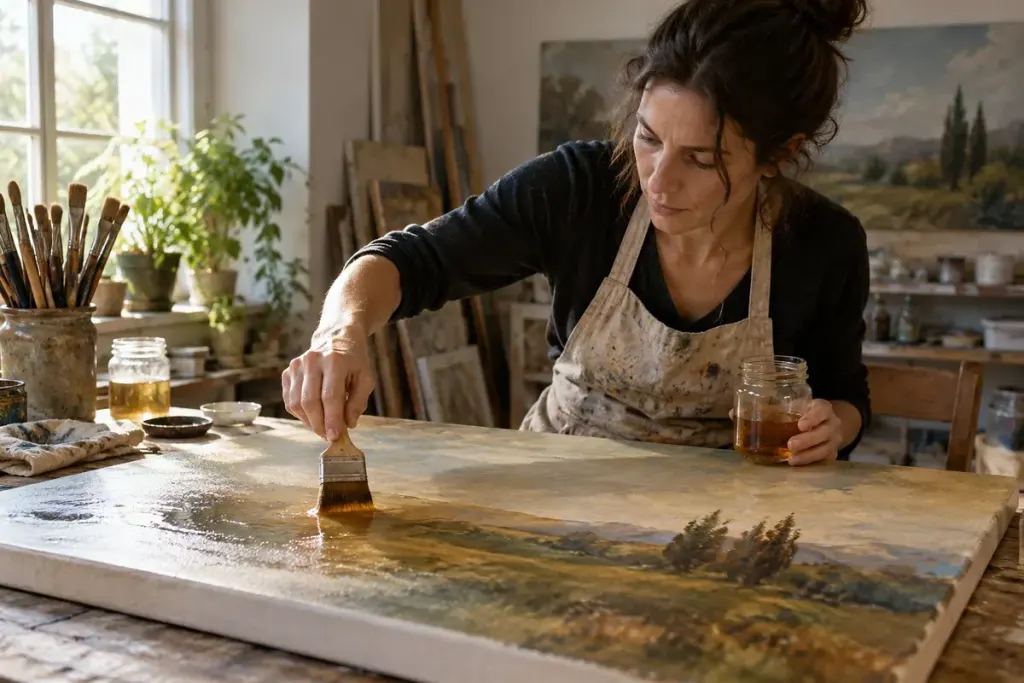
A thin amber layer can warm a painted sky without hiding every mark underneath it. The result depends on light passing through the upper colour and interacting with what is already there. That is the appeal of glazing: the earlier painting remains part of the new colour.
Golden Artist Colors’ technical publication Just Paint describes glazing with acrylics and the wet-to-dry change associated with acrylic medium. A mixture that looks cloudy while wet may become clearer as it dries. Judge the dry test rather than repeatedly correcting the wet appearance.
Make a test that answers one question
On a spare prepared surface, paint a light area, a dark area and a narrow line crossing both. Let that layer dry properly. Mix a small quantity of a transparent acrylic colour with a compatible glazing medium, following the product instructions, and brush one thin pass across the three features.
After it dries, examine what happened:
- Can the narrow line still be seen clearly?
- Did the pale area become warmer or simply darker?
- Is the glaze even, or did it gather at the edges?
- Does the finish differ from the unglazed area?
Write the colour and medium beside the sample. If you want a stronger effect, test another dried layer on only half of it. That comparison is more informative than changing the mixture halfway across the whole painting.
Transparency begins with the colour choice
Adding medium spreads pigment through more binder, but an opaque pigment does not behave exactly like a naturally transparent one. Read the paint maker’s transparency information and test the actual colour. Do not assume every blue or every yellow will produce the same kind of veil.
Use a soft, suitable brush and avoid scrubbing an underlayer that has not settled. Follow the medium’s drying guidance and keep the first experiment small. A glaze is easier to build gradually than to remove from an acrylic painting. The most useful sample is one you can hold next to the work and understand, including the less successful half.