
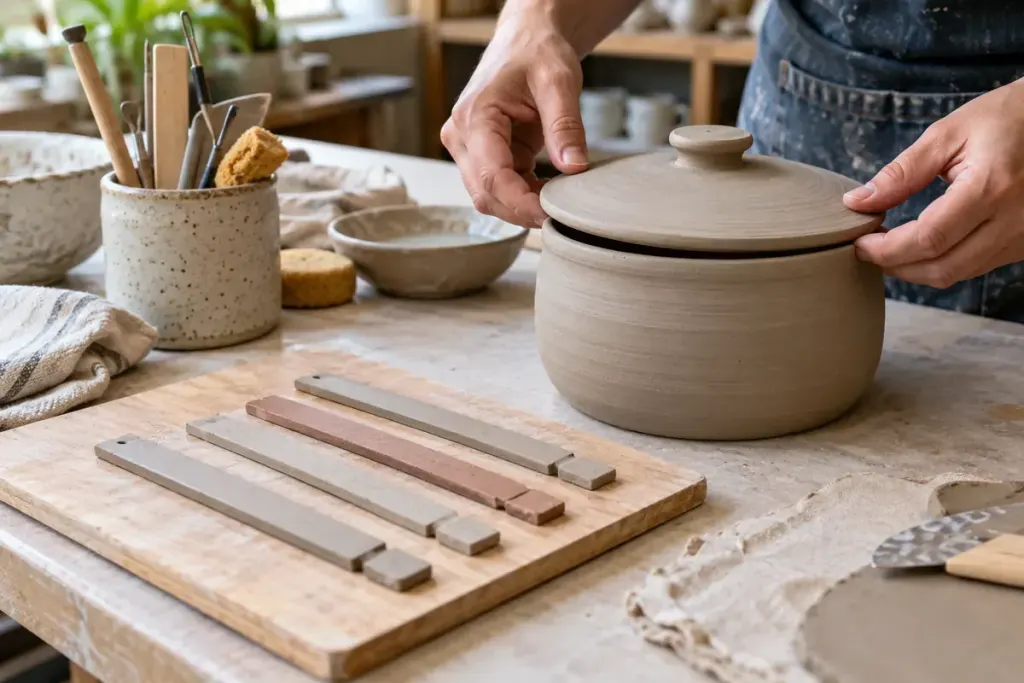
A lid that fits perfectly while wet can become a frustrating puzzle after firing. Clay changes size as it dries and fires, and the result depends on the body and firing conditions. Before committing to a fitted decorative box, make a small shrinkage test with the same clay and the same studio process.
Digitalfire’s SHAB procedure describes a systematic test for drying shrinkage, firing shrinkage and absorption. A home-studio length comparison addresses only part of that procedure: it does not establish food safety, glaze compatibility or every property of the finished body. Ask the studio technician which test format will work with their kiln records.
Keep three measurements distinguishable
Make a flat test bar and mark a measured reference distance while the clay is workable. Measure between those reference marks rather than relying on corners that may become rounded. Record the clay identity, starting distance and date. After the sample is fully dry, record the distance again; after the intended firing, take the final measurement.
As an invented example, a wet reference distance of 100 mm that becomes 88 mm after firing represents 12% total linear shrinkage from the wet state. Do not confuse that with the shrinkage between the dry and fired stages. Each percentage needs its own starting measurement.
The design arithmetic runs backwards. If a uniform 12% reduction were a reliable result for your process, a desired final distance of 88 mm would start at 88 divided by 0.88, or 100 mm. Adding 12% to 88 does not produce the same answer.
Use the calculation as a planning aid, then test the actual lid and seat geometry. Uneven thickness, warping and different drying conditions can defeat an apparently correct allowance. Keep the bar beside its firing notes, and repeat when the clay body or firing schedule changes. A measured sample is more useful than a shrinkage percentage remembered without its conditions.