
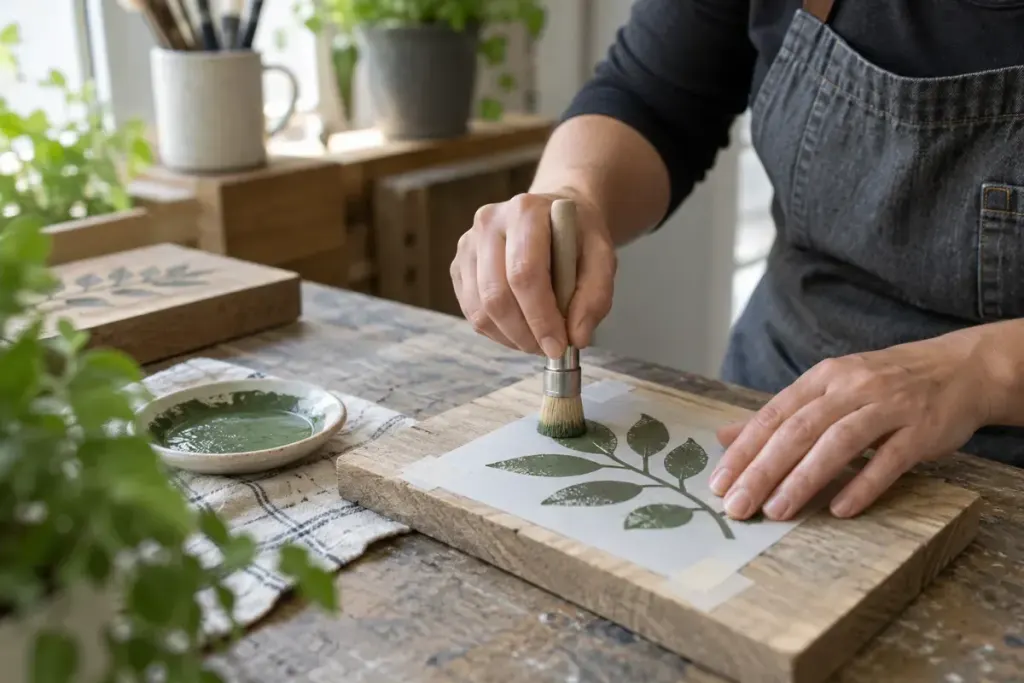
You lift the stencil and find a soft halo where you wanted a crisp leaf. The outline may be fine; the paint may simply have travelled underneath it. More paint is not always the route to better coverage.
A scrap test lets you separate three variables: how the stencil sits, how much paint is on the tool and how you apply it.
Make the surface and stencil steady
Use a clean, prepared surface compatible with the paint and stencil method. Secure the stencil in the way its maker recommends, testing any tape or repositionable adhesive where it will not damage the finish.
Raised grain, a curved object or gaps at an edge can make contact uneven. Do not assume a stencil that worked on smooth card will behave identically on rough wood.
Unload the brush before touching the design
Take a small amount of paint and remove the excess onto a suitable palette or scrap. The tool should be lightly loaded rather than dripping. With a stencil brush, use controlled dabbing or the method recommended for that product instead of pushing a wet brush sideways under the edge.
Build the effect gradually. If you want greater opacity, follow the paint’s drying and recoating instructions rather than flooding the opening in one pass. A roller or sponge has its own loading behaviour, so test the actual tool you intend to use.
Compare two small sample marks: one from the first load and one after unloading more paint. Keep the surface and application motion the same. The result often explains the edge better than changing the entire design.
Lift, inspect and clean
Remove the stencil according to the product method without dragging it across wet paint. Inspect the underside before repeating the pattern; paint transferred there can print an unwanted mark on the next section.
Clean tools as directed and keep the working area ventilated as required by the materials. A crisp result comes from several controlled choices, and a deliberately textured stencil can also be attractive. The point is to choose the effect rather than discover it after decorating the final object.