
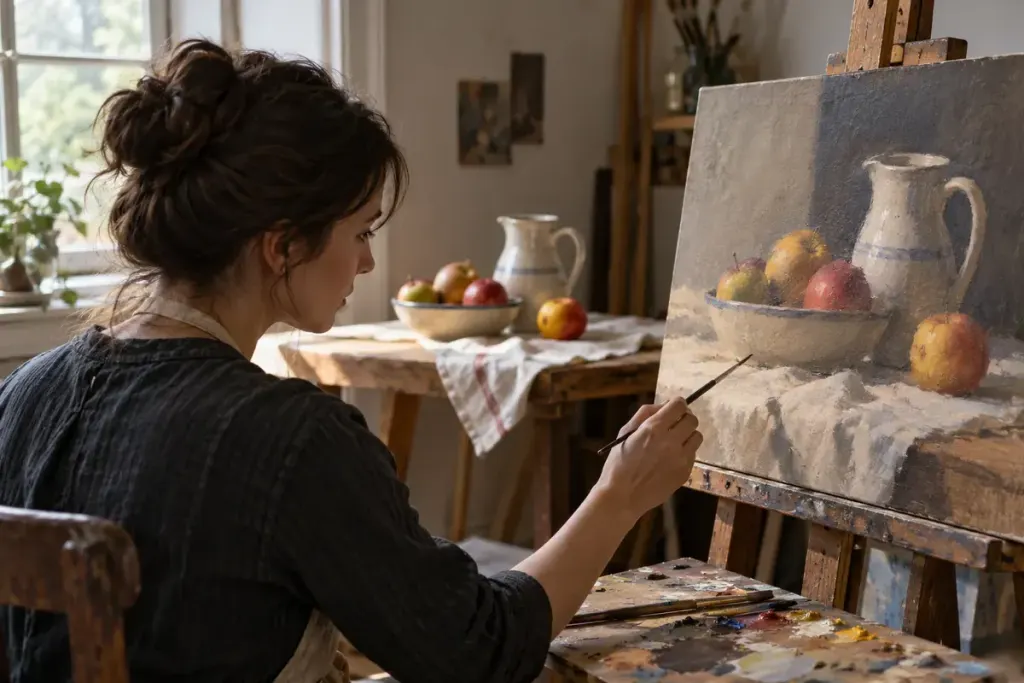
Trace every object with an equally sharp outline and a painting can begin to resemble a collection of cut-outs. Real scenes rarely separate themselves so evenly. A pale cup may nearly disappear against a pale wall on one side, then become unmistakable where its rim meets a dark shadow.
Painters call this variation lost and found edges. The object has not disappeared; part of its boundary is less explicit. In a first-person painting demonstration, Artists Network discusses lost and found edges as a way to connect forms with their surroundings and suggest atmosphere.
Place a plain mug against a background of a similar value. Light it from one side and make a small study with only a few colours. Before painting, identify the clearest edge, the least visible edge and a transition between them.
Paint the broad light and dark shapes first. Then decide where a sharper boundary helps the viewer recognise the mug. Leave another section quieter instead of immediately outlining it. Step back to see whether the form still reads.
This is an observation exercise, not an instruction to blur the whole picture. Softening every edge equally replaces one uniform treatment with another. A lost edge also need not be a smudged edge: two adjoining shapes of similar value can merge without a conspicuous soft-focus effect.
Repeat the subject, but make a different edge the clearest one. Compare where your eye arrives first and how the mug sits in the space. Keep the lighting and composition stable so the comparison is mostly about edge choices.
If the form becomes unreadable, restore one useful landmark rather than redrawing the entire perimeter. The handle junction or a short section of rim may be enough. Note what changed in the two studies in ordinary language: “the left side joins the background” is more useful than declaring that one is simply more artistic.
Small studies make this experiment inexpensive. They give you a reason for each crisp edge when you return to a larger painting.