
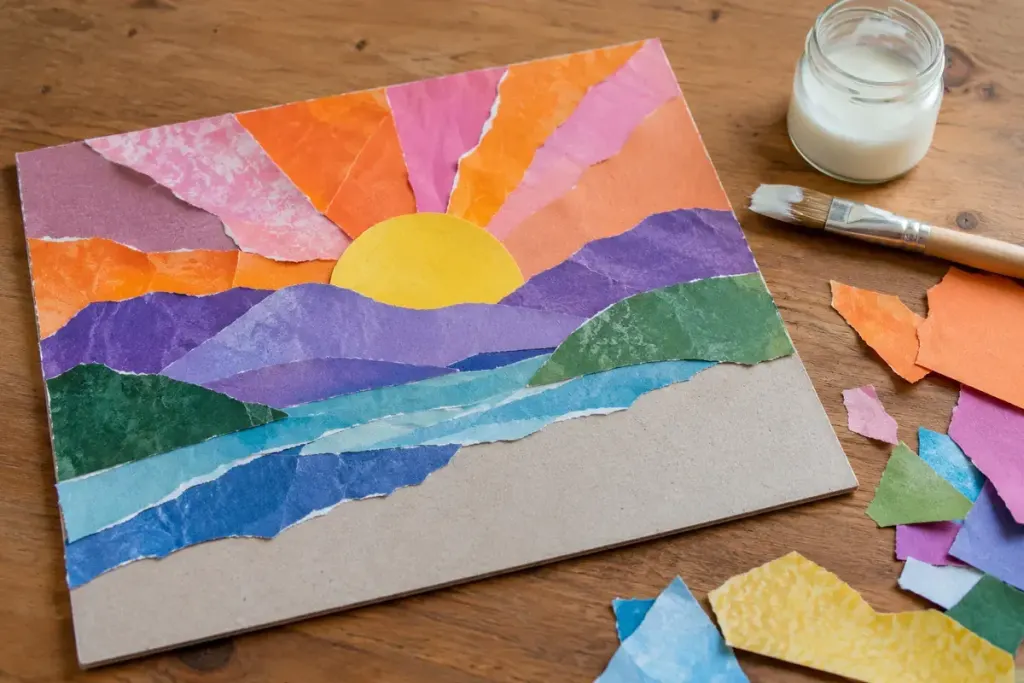
A collage can look settled while it lies flat and start lifting at the corners the first time someone picks it up. The problem is often not the composition. Thin support, heavy layers and poorly planned joins have been asked to behave like one rigid sheet.
Before you glue a full design, make a small handling sample with the actual materials. This is a practical studio exercise for ordinary craft papers, not a conservation method for valuable documents or photographs.
Give the collage a job
Decide whether it will be framed, pinned to a board, sent as a card or handled repeatedly. A decorative piece for a frame has different demands from a cover that will bend every day. Choose a support that suits the intended job, and check the adhesive’s instructions for both surfaces.
Try a scrap of your thickest paper, your thinnest paper and any glossy printed piece. They may react differently to the same adhesive. If a test wrinkles, stains or refuses to hold, learn that on the scrap.
Plan which edge sits on top
Arrange the pieces without glue and take a reference photo. Then work out the order of the overlaps. A small foreground shape may need to go down last, even if it was the first piece you cut.
For a simple landscape, imagine a broad sky, two hills and a narrow path. The path can disappear beneath the nearer hill rather than end with a visible cut edge. Thinking about the join gives you a cleaner result without needing a perfectly precise cut in every place.
- Keep an unglued arrangement beside the working area if space allows.
- Use the amount and application method stated for the adhesive.
- Protect the table and keep glue off areas that must remain clean.
- Allow the specified drying time before judging the bond or stacking the work.
Test it as the recipient will handle it
Once the sample has dried, lift it from the edge, stand it upright and gently handle it in the way the finished piece will be used. Look for unsupported corners and stiff layers pulling against a flexible base. Do not deliberately bend a piece intended to remain flat.
If the result is awkward, simplify a layer or change the support before committing the whole design. Adding more glue everywhere is not a reliable answer to a mismatch between materials.
Keep the small successful sample with a note naming the paper and adhesive. On the next project, it becomes a useful physical reference: something you have actually handled, rather than a combination you vaguely remember working.