
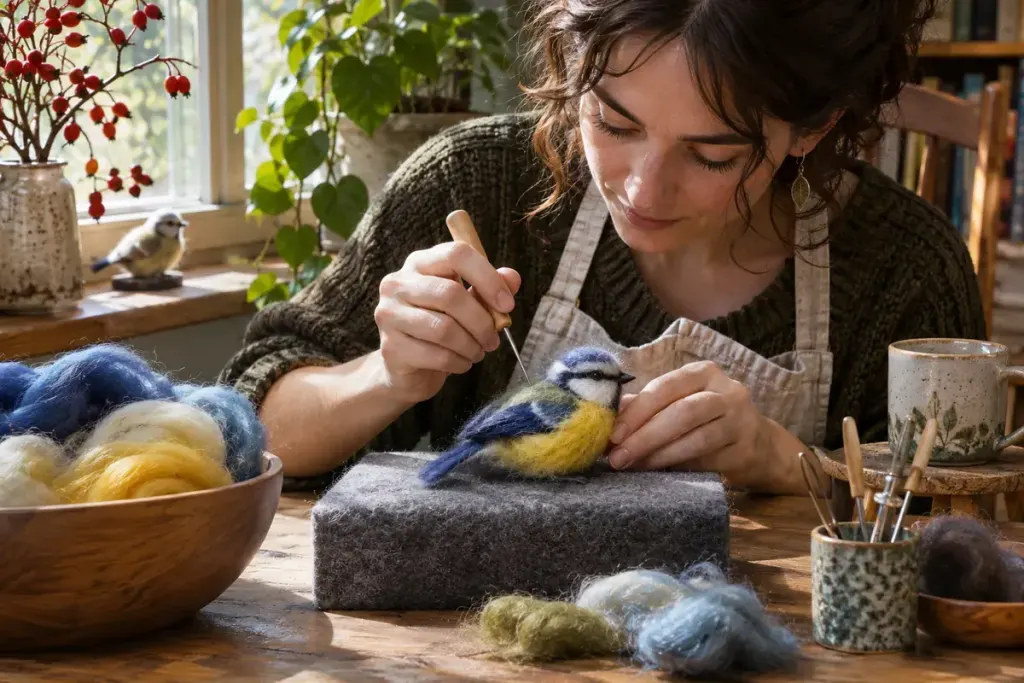
A loose handful of wool can become a rounded bird without water, stitching or glue. Needle felting works by repeatedly passing a specially barbed needle through the fibres. The fibres become entangled, gradually holding the shape you build. The tiny punctures do the work; pressing a large amount of wool into a rough outline is only the beginning.
Ashford’s introductory needle-felting guide uses a protective foam surface and small amounts of wool. The support underneath matters: it receives the needle beyond the work, instead of leaving a hand or tabletop in its path.
Build a form you can turn
For a first experiment, make an egg-shaped body before adding a beak or wings. Roll a small amount of wool into a compact bundle and work it on the mat. Turn it frequently, bringing a different surface uppermost. If you work only on the top, the piece can become flat on one side while remaining loose underneath.
Pause to compare the two ends. One may need a little extra wool; the other may simply need more evenly distributed needling. These are different corrections. Adding material to a loose area without first examining its shape can make the whole bird larger than intended.
The needle is a tool, not a handle for bending wool
Keep fingers clear of the puncture line and move the wool while the needle is out. Push and withdraw along the same direction; levering the needle sideways puts stress on a slender tool. Use a suitable holder and follow the tool maker’s instructions. Put needles away securely between sessions.
Different needles serve different stages. For example, Ashford describes its fine 40-gauge needle as useful for detail. That does not make a fine needle the quickest choice for forming a large loose body.
A useful practice record is a photograph of the same shape from above, from the side and standing upright. It reveals uneven volume more clearly than judging the piece only while it is in your hand. Aim for a deliberate silhouette before adding decorative detail.