
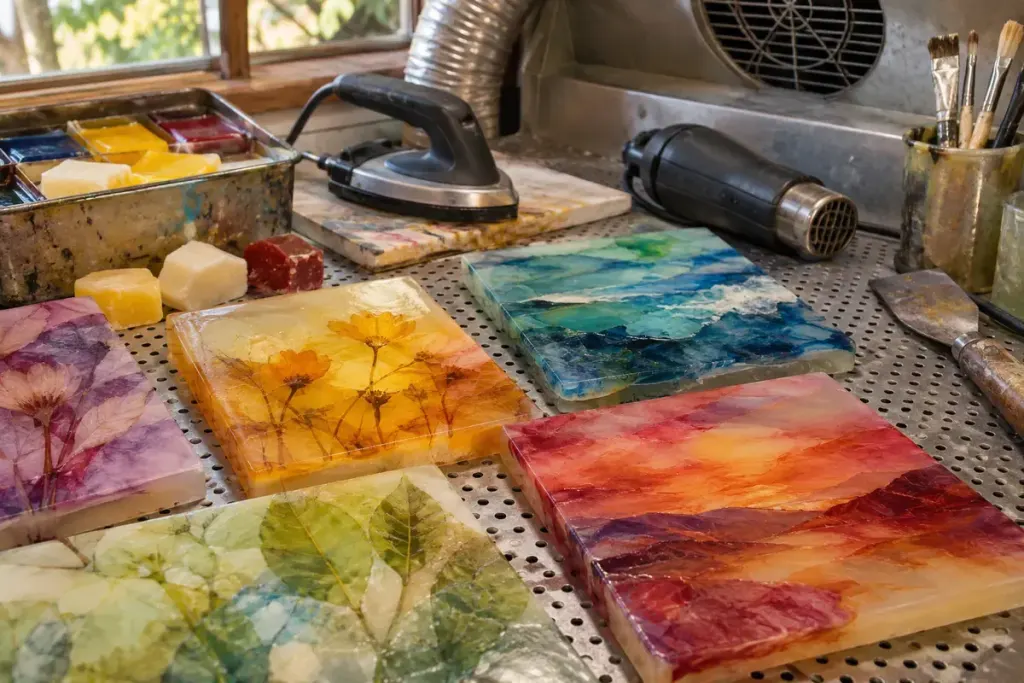
Some encaustic paintings seem to hold colour beneath their surface. A pale passage may reveal a darker mark below it, while another area looks dense and sculptural. These effects come partly from the way wax-based paint is layered and joined through heat.
Encaustic is not simply a painting sealed with candle wax. It is a medium with its own materials, supports and working methods. Understanding the purpose of fusing makes a workshop demonstration much easier to follow.
Look at the join between layers
R&F’s encaustic manual explains that each applied layer should be fused. Controlled heat joins it to the layer beneath. The degree of fusing also affects the surface, so the artist is managing both attachment and appearance.
A translucent layer can leave earlier marks visible. An opaque colour can conceal them. The same manual describes glazing with medium and scraping back to reveal earlier material, showing that building an image can involve removal as well as addition.
A useful way to watch a demonstration
Choose one small area and follow it through three stages: paint applied, heat introduced, surface cooled. Notice whether a sharp mark softens or a ridge becomes smoother. Ask the instructor which change was intended. This is more revealing than trying to memorise every tool on the table.
For a first workshop, ask what support and prepared materials will be supplied, how temperature is controlled, and what ventilation and protective measures the studio uses. Follow the manufacturer’s guidance and the instructor’s safety arrangements. An improvised domestic heating setup is a poor substitute for an appropriate workspace.
Read the finished surface slowly
At an exhibition, look from an angle as well as straight on, without touching the artwork. Side lighting may reveal relief that disappears in a flat photograph. A cloudy area could be an intentional layer effect rather than a flaw.
The Hirshhorn’s discussion of wax as an artistic material highlights its translucency and sensitivity to heat. Display and transport therefore deserve the artist’s specific advice.
For your notes, describe a visible effect before naming a technique: “a red line beneath a pale veil” is a better starting observation than assuming you know exactly how it was made.