
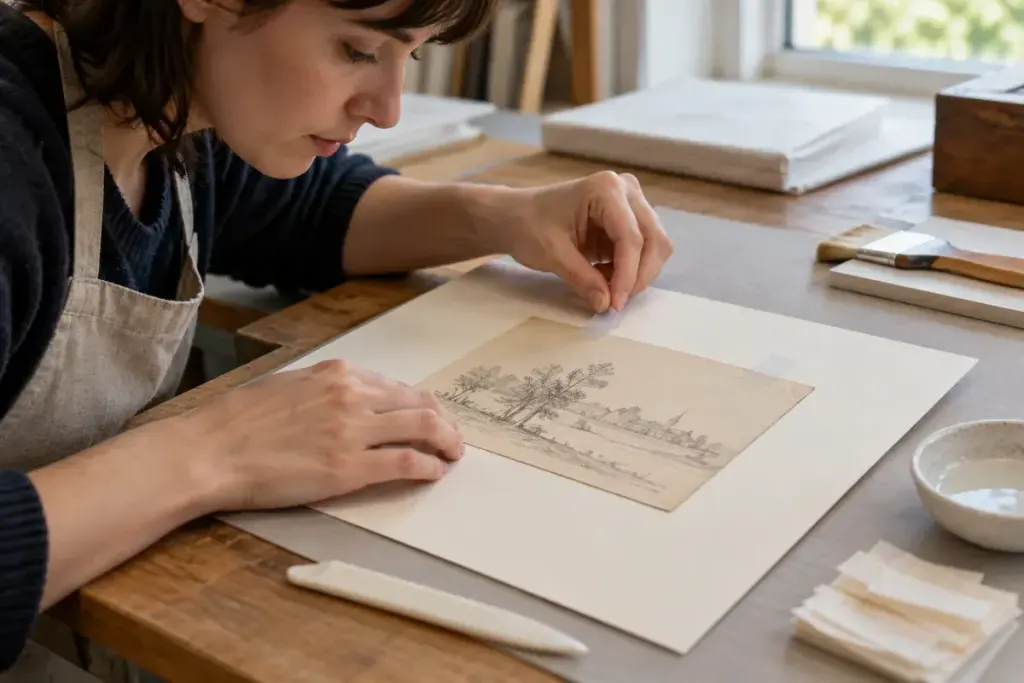
A drawing can look flatter when every edge is stuck down, but paper responds to changes in its environment. Fixing the entire sheet rigidly to a backing can create problems that are difficult to undo. Mounting should support the work without treating it like a label.
The Library of Congress guidance on paper hinges recommends conservation experience because paper choice and introduced moisture require expertise. For valuable, fragile or irreplaceable work, consult a qualified paper conservator. The exercise here is for understanding the arrangement on an expendable practice sheet, not choosing an adhesive for an old family drawing.
Look at what carries the weight
A paper hinge connects a limited area of the artwork to its support. Its material, adhesive, position and strength need to suit the paper. “Archival” on a packet is not enough information to establish that a product is appropriate for every artwork.
Lay a practice drawing on the intended support and decide how the mount will reveal it. Mark positions on a separate planning sheet. Keep adhesive away from the original while you work out the geometry, and avoid letting the picture’s placement depend on a single hurried eyeball measurement.
Consider how the framed object will hang. The support must carry the sheet appropriately in that orientation, while the window mount or spacers keep the image surface away from glazing where needed. A decorative border and a structural attachment do different jobs.
Ask about reversibility
Before approving a framing method, ask how the work could later be removed and what would remain on it. Avoid ordinary pressure-sensitive tape, spray adhesive or a full coating of glue as an improvised solution to a curling corner.
Keep a record of the materials and method used. If the work later needs conservation, those details are useful. The best-looking mount is not only neat on the day it leaves the table; it also respects the object when somebody needs to examine or reframe it years later.