
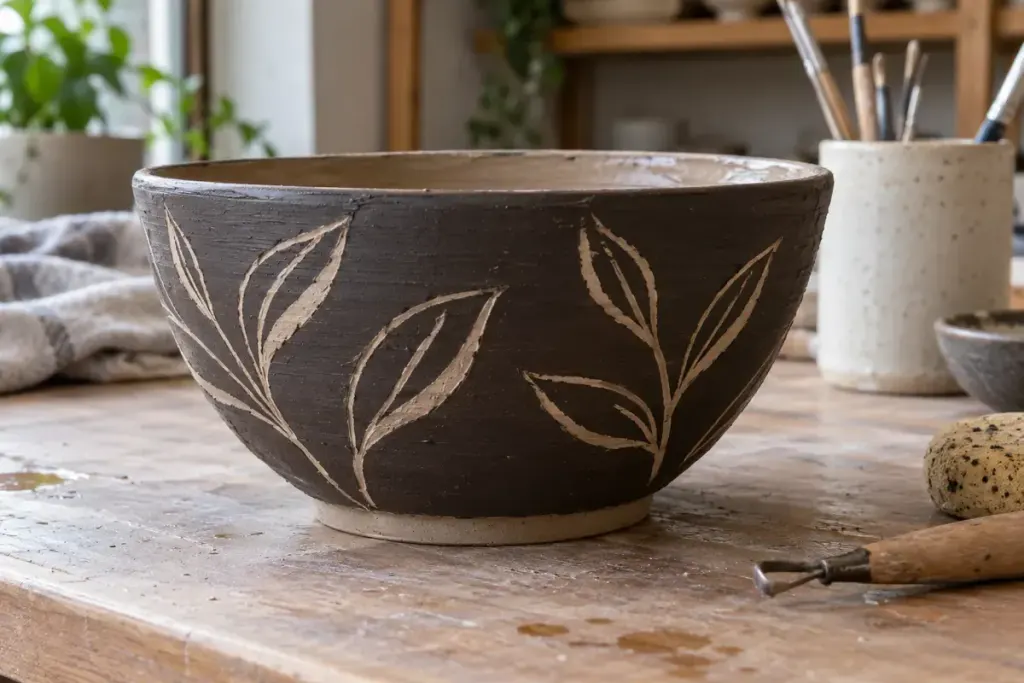
A pale leaf line on a dark ceramic bowl may have been drawn by removing colour rather than adding it. In sgraffito, the maker scratches through a surface layer to expose a contrasting layer below. The line is both an image and a shallow physical cut.
The V&A’s guide to ceramic techniques describes incision through slip to reveal the clay body beneath. Looking for that relationship between the coating and the exposed body helps distinguish sgraffito from a painted line that sits on top of the surface.
Start with a small design that has room to breathe
On a test tile, try a single leaf, several parallel curves or a simple border. Leave an untouched area beside the marks. The comparison makes it easier to see whether the scratched lines are clear enough and whether removing more coating improves the design or merely makes it busy.
Clay condition matters. Material that is too soft can drag and distort; a surface that has become too dry may chip or create dust. Ceramic artist Patricia Griffin’s sgraffito demonstration discusses working at an appropriate stage and choosing a manageable surface. Follow your studio’s material and dust-control procedures rather than dry-sanding a mistake at the table.
Try more than one line width on the sample. A broad removal can create a light area, while a narrow incision can describe an edge. Notice how the design reads from an arm’s length away, not only when your face is close to the clay.
The fired sample answers the final colour question
The wet coating is not a dependable preview of the finished colour. Use compatible clay, slip or underglaze and the firing schedule specified for those materials. Record what went on the tile and how it was fired. If a glaze is added, judge whether it preserves the contrast and detail you wanted.
A successful sample need not become a finished object. Its job is to show which combination of surface firmness, tool and material gives you a repeatable mark. Keep that evidence before moving the design onto a larger bowl.