
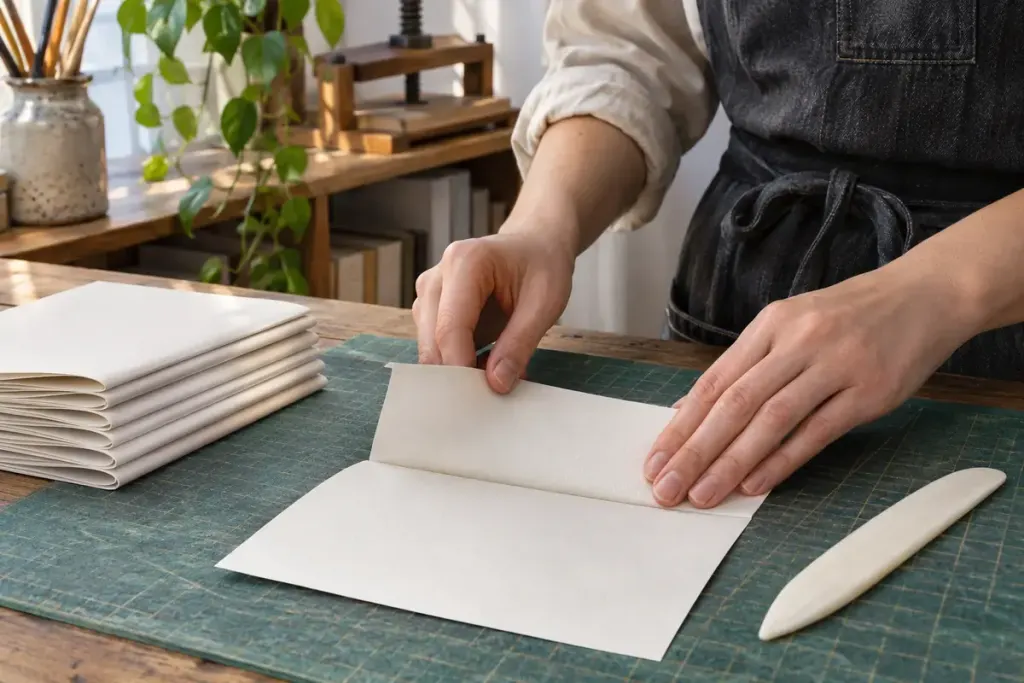
A small handmade book can resist opening even when the sewing is tidy. Before tightening the thread or pressing harder on the spine, look at the paper. Its fibres have a predominant direction, and that grain changes how a sheet bends.
Dartmouth Library’s book-repair manual describes a gentle comparison: bend the sheet in each direction without creasing it. Bending parallel to the grain offers less resistance. For book construction, aligning that direction with the spine helps the book open more smoothly.
Find the direction before cutting the page size
- Take a spare sheet from the stock you intend to bind.
- Curve it loosely in one direction without making a crease.
- Release it and compare the resistance when curving the other way.
- Mark the easier direction lightly in a waste area.
If the difference is subtle, test another sheet rather than forcing a crease into the final paper. Keep that test sheet beside the cutting plan so the observation is not lost when the stack is rotated.
Now sketch the finished page and the fold that will become the spine. A sheet sold in a convenient size does not automatically have its grain running in the direction needed for your folding plan. Rotating the layout can change how many pages fit, so settle the grain question before calculating the cutting yield.
Build one small section as a rehearsal
Fold a few test sheets into a signature and open them gently. Compare their behaviour with a second sample folded the other way if enough spare paper is available. Label the samples so the comparison remains useful when you return to the project later.
Check cover paper and board as well as the text pages. Dartmouth’s guidance also stresses matching grain when adhering materials together. Glue, thickness and construction still affect the result; grain alignment is one important decision, not a cure for every stiff binding.
Use this exercise for new craft work and expendable samples. Do not repeatedly flex an old or valuable book to diagnose its paper, and do not force a reluctant volume flat. For the next handmade notebook, a two-minute grain test is a better starting point than trying to persuade the finished spine to behave differently.