
Most drawing lessons begin with a light sheet and a dark mark. Mezzotint invites you to imagine the reverse: a surface prepared to print dark, from which the artist gradually brings out light.
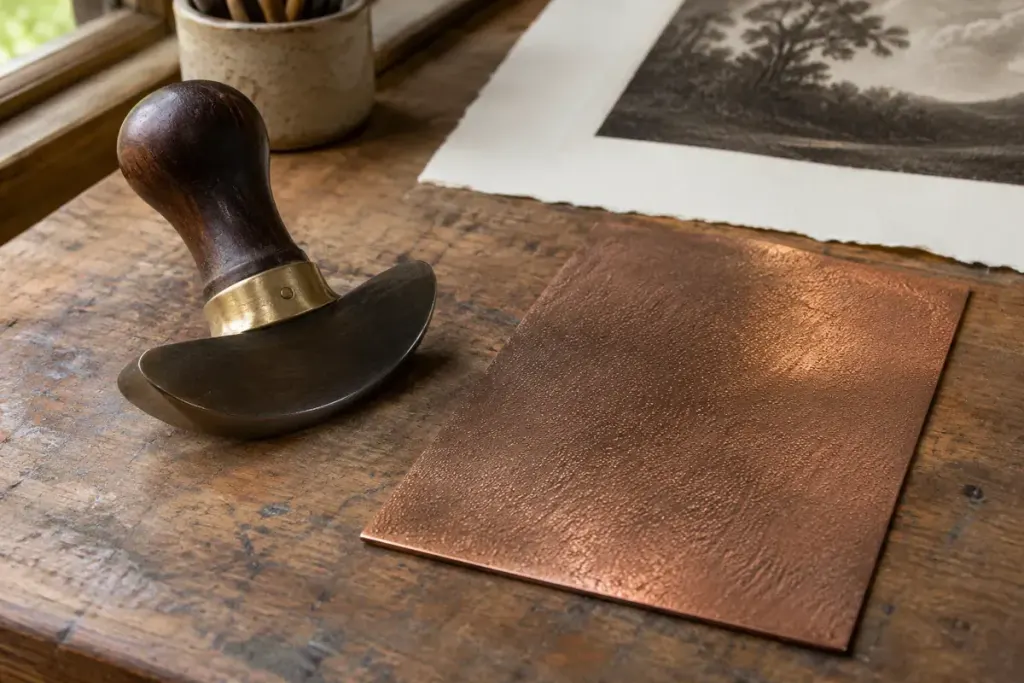
The Metropolitan Museum of Art’s explanation of mezzotint describes a copperplate roughened with a toothed rocker. The resulting burr holds ink. Scraping and burnishing selected areas reduces that ink-holding texture, producing lighter passages in the impression. The process is particularly suited to gradual tonal transitions.
That account changes the way a viewer can look at a face, a fold of cloth or a dark background. The bright area is not necessarily an added white pigment. It may be the part of the plate that has been worked so that it carries less ink to the paper.
A looking exercise with three stops
- Find the deepest dark. Is it one large mass, or does it contain distinctions you missed at first?
- Follow a transition. Choose the side of a face or a rounded object. Notice where the light seems to turn rather than treating the form as an outline filled with shading.
- Check a sharp edge. Compare it with the softer transition. How does the contrast guide your attention?
Use a museum’s high-resolution image when possible, but remember that the screen is another translation. A low-contrast reproduction can flatten exactly the subtle tonal differences that make the technique interesting. Look at the catalogue’s medium field rather than identifying a process from darkness alone.
For a studio exercise inspired by this way of seeing, start with a charcoal-covered sheet and lift out the light on a simple cup using an eraser. This is a drawing exercise, not a substitute recipe for making a mezzotint plate. Its value is the changed question: instead of “where should I add another line?”, ask “where does removing darkness make the form clearer?”
That question is useful even if you never touch a rocker. It makes the unmarked or lightened parts of an image feel as deliberate as the dark ones.