
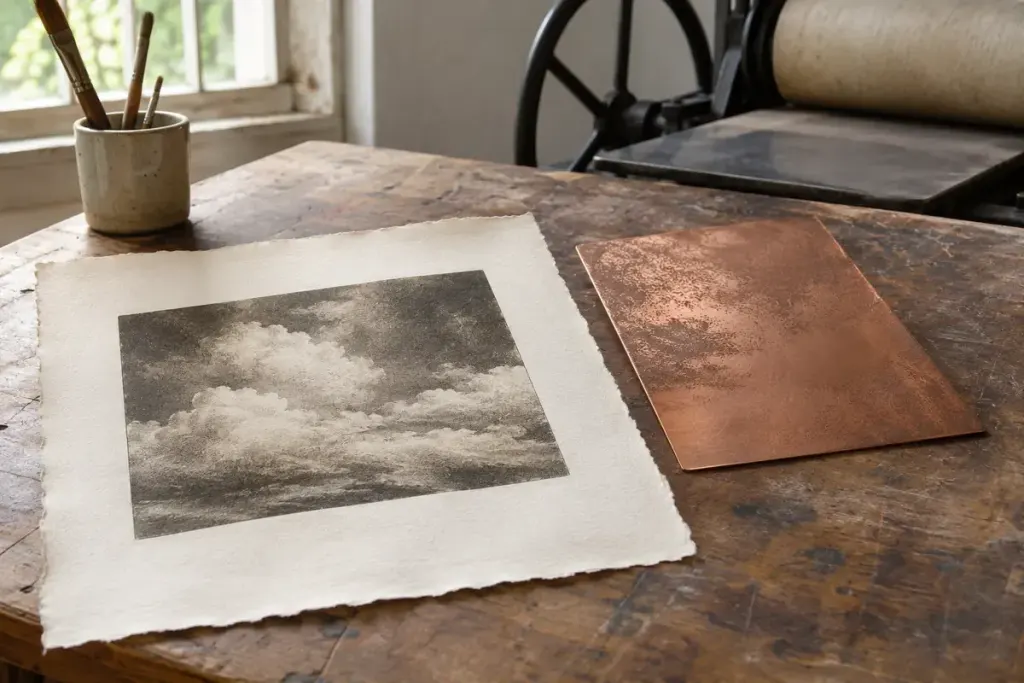
Stand back from an aquatint and its shadows can resemble a wash of ink. Move closer and the apparently smooth grey begins to reveal a fine grain. That change in viewing distance is a good introduction to what the process contributes to a print.
Aquatint is an intaglio technique used to create tonal areas on an etched plate. In the traditional process, small particles of resin protect parts of the metal while an etchant works around them. The resulting recesses retain ink. The Metropolitan Museum of Art’s account of aquatint explains how the process can produce a range from light tones to deep darks, including on plates that also contain etched or engraved lines.
Give the tone a job
When looking at a landscape print, try covering the most sharply drawn feature with a piece of paper held in front of the image without touching it. What remains may still suggest mist, distance or a patch of heavy weather. The tonal areas are carrying information that an outline alone would not provide.
Now reverse the exercise mentally. Imagine the same composition reduced to its lines. A dark doorway might become an empty rectangle; a hillside might lose its sense of receding. This is a viewing exercise, not a claim about the artist’s exact working sequence.
Compare a light patch beside a dark one. Is the boundary abrupt, or does it pass through several intermediate tones? Are small white spaces reserved within the grain? These questions help you notice decisions that can disappear when every dark area is simply called “shading.”
Read the medium line on the label
A museum label may list etching and aquatint together. That combination does not mean the image was printed from two unrelated pictures. Different methods can contribute to a single plate and impression. The Met’s discussion of Goya offers examples of how assertive lines and surrounding tone can work together.
For a sketchbook response, make a small drawing with three tonal values and one line weight. Decide where tone should establish space and where a line should identify an edge. You can explore that relationship with pencil or wash without handling printmaking chemicals.
Actual aquatint production belongs in a properly equipped, supervised printmaking setting. As a viewer, the rewarding first step is simpler: look once at the scene, then look again at how its greys were built.