
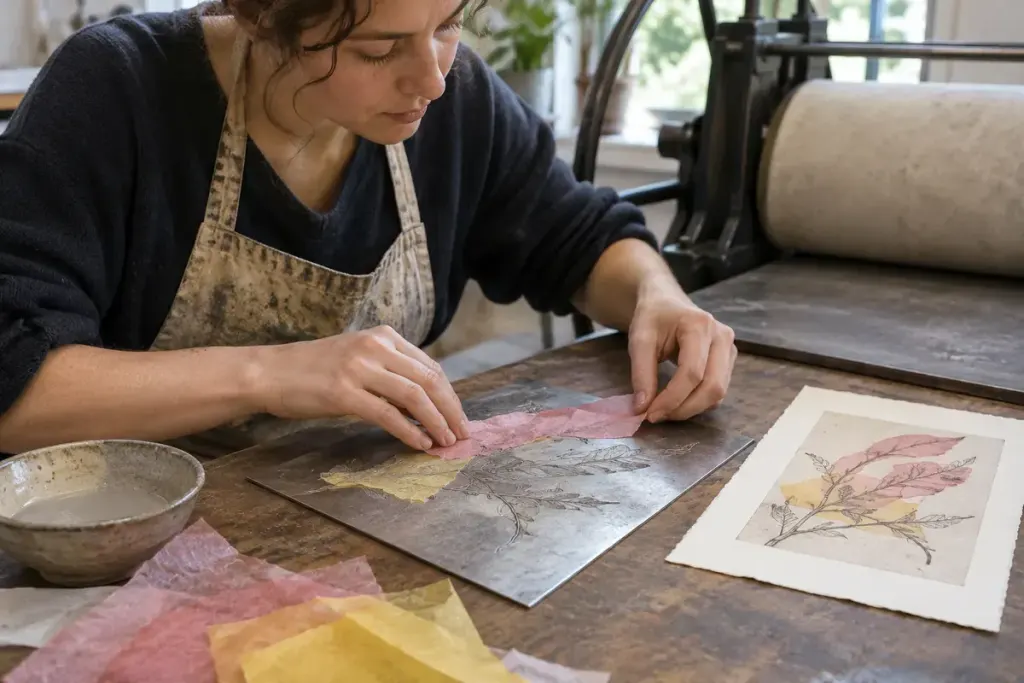
A print can have a coloured paper area that feels integrated with the image rather than pasted on afterwards. In chine colle, a delicate paper and a stronger support are brought together as part of the printing process. The paper contributes colour, texture and a different surface for the printed marks.
It is an appealing technique for a small edition because the added colour does not have to come from another separately inked printing plate.
Two papers, one planned impression
MoMA’s definition of chine colle describes a tissue-thin sheet supported by a larger, thicker paper. The University of the West of England’s printmaking workshop description characterises the technique as bringing collage and printing together in a single impression.
That combination makes placement important. The thin sheet is part of the print’s construction, not merely decoration added wherever a blank space remains. Its edge can emphasise a shape, change a background or deliberately interrupt the relationship between image and support.
Plan the experiment before preparing adhesive
Make a dry paper mock-up first. Cut a few alternative shapes from inexpensive practice paper and place them over a photocopy or earlier proof. Photograph the options. This lets you judge composition without repeatedly handling a fragile prepared sheet.
In a supervised studio session, ask about suitable tissue, adhesive, moisture and press settings for the particular printing process. Materials that behave well in one workshop may not transfer directly to another setup. Follow the studio’s press-safety procedure and avoid improvising pressure adjustments.
For a first trial, change only the thin paper between two otherwise comparable proofs. Label the backs after drying so you can distinguish the material rather than relying on memory. Look at how the line reads across the coloured area, whether the paper lies flat, and whether the edge belongs to the composition.
If the result feels busy, try a smaller or quieter paper shape before changing the whole image. Chine colle can be subtle: a small shift in the paper under a printed line may do more than a large block of colour. The strongest choice is the one that makes the print easier to see on its own terms.