
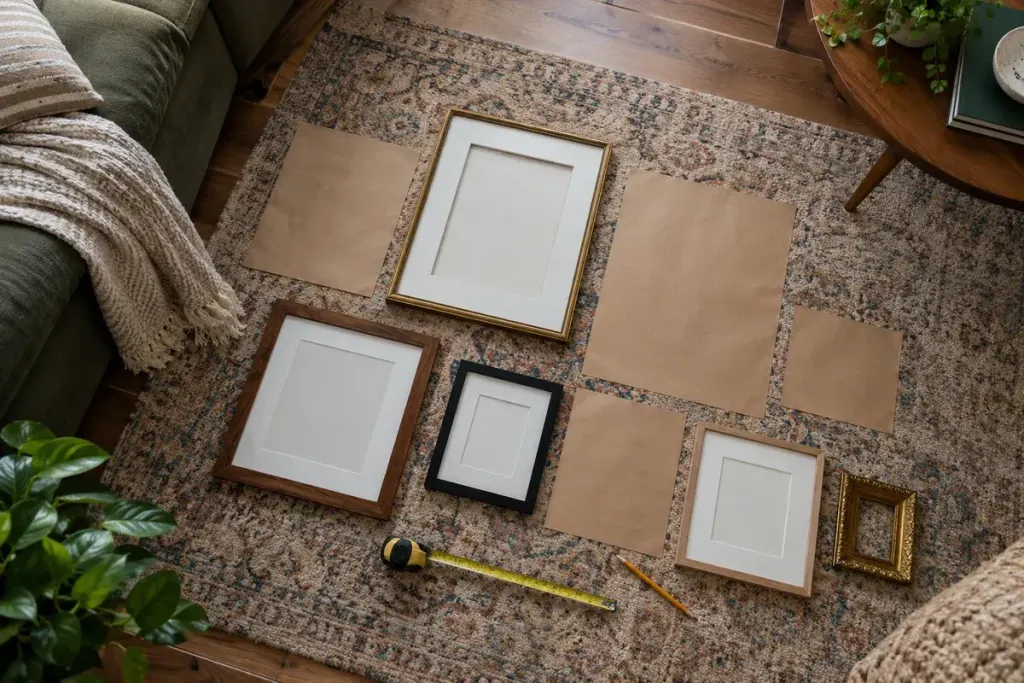
The frames are lovely individually, but together they seem to drift across the wall. One feels too heavy, another disappears, and the gap above the sofa looks accidental. You can solve much of this without making a single hole.
Start on the floor with the actual frames. Their outside edges, colours and proportions matter as much as the artwork inside. A layout that works with printed image sizes alone can change once thick borders enter the picture.
Give the arrangement one organising idea
Choose a shared centre line, a loose rectangular boundary or a larger frame that anchors the group. You do not need all three. Place the strongest piece first, then move the smaller ones around it until the group feels intentional from a few steps away.
Photograph two alternatives from above. Looking at them on a small screen can reveal a crowded corner that you missed while kneeling beside the frames. Label the options in your notes so you can compare them later without endlessly rebuilding the same arrangement.
Move the outline onto the wall
IKEA’s gallery-wall guide suggests paper templates to test frame placement. Trace the outside dimensions and use a temporary fixing suitable for the wall finish. Test that fixing discreetly first; even removable tape can damage some surfaces.
Check the composition while seated, standing and entering the room. Open nearby doors and consider lamps, curtain movement and furniture height. The wall is part of a lived-in room, not an isolated rectangle in a photograph.
Translate the layout into hanging points
The top of a frame is not necessarily where its hook belongs. Measure the actual hanging hardware, including how a wire sits under tension. Mark the appropriate point on each template so a carefully spaced design does not shift during installation.
Choose fixings rated for the frame and suitable for the wall construction. Check for concealed services before drilling and seek qualified help when uncertain. Heavy glazed frames above seating or beds deserve particular care; appearance does not determine whether a fixing is safe.
After hanging, remove the templates and adjust the small details. Keep a photograph of the finished arrangement and the frame measurements. When a new print joins the collection, you can revisit the composition as a whole instead of squeezing it into the nearest empty gap.