
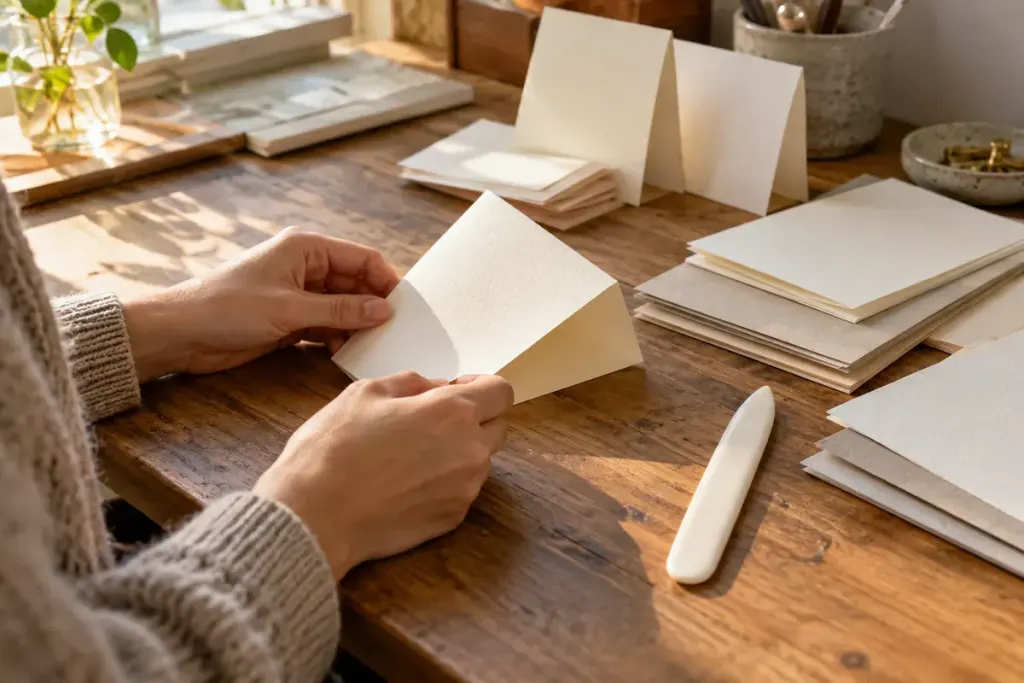
A sheet can look smooth until you fold it. Then a pale crack appears along the printed surface, or the fold springs open instead of lying neatly. The design may be sound; the paper simply needed a trial before the final cut.
Make two small folds
Take a spare piece from the same stock and fold it gently in one direction. Try another piece at right angles. Many papers behave differently along and across their grain. Compare the resistance, the straightness of the fold and any surface cracking. Use the more cooperative direction where the design and sheet size allow.
Keep the sample’s orientation marked with a light pencil note. Otherwise it is surprisingly easy to rotate the remaining sheet and lose the information you just gained.
Score without cutting
A blunt scoring tool and an appropriate surface can help establish a fold in heavier stock. Start with light pressure on a test strip, guided by a ruler that will not slip. Inspect the face and back before repeating the pressure on the finished piece. A deep groove that weakens or tears the surface is not a better score.
Coated, textured and printed papers respond differently. If a dark printed area crosses the fold, test that area specifically; an unprinted margin may conceal a problem that will be obvious on the final card.
For a booklet, fold a small dummy using the same number of sheets. Several nested sheets change how the edges sit, even when each sheet folds neatly on its own. Check that the cover still reaches where you intended and that the booklet closes without being forced.
Keep the successful sample with the stock name and tool note. The next project then begins with a physical reference instead of a vague memory of “quite firm pressure.” A five-minute paper trial can protect an hour of careful printing and cutting.